|
CHART DATA AS OF NOVEMBER 19, 2001 A SPECIAL REPORT BY ALAN M. NEWMAN, EDITOR LONGBOAT GLOBAL ADVISORS CROSSCURRENTS |
| What a difference a couple
of months make! Since September 21st, the market has been celebrating
each news announcement, bad or good - a circumstance that has led many
observers to believe a brand new bull market is underway. The parade
of the "it's a brand new bull market!" analysts have already begun to pass
in review on CNBC, citing the Dow's 20%+ gains from the brief 9/11-9/21
plunge as proof.
The truth is that manias die hard..... The secular bull market that began in 1982 was very kind for a very long time. Other than a few brief timeouts such as the few months from August 1987 to December 1987, the few months from July 1990 to January 1991, and a two month slide in 1998, it was easy sledding all the way into March of 2000. Nearly eighteen years! This was the longest running success ever for U.S. stocks. The apparent "permanence" of rising prices catalyzed a 180 degree shift in how risk was viewed and accomplished the following:
The stance of the financial industry is to do business as if nothing had happened. The mantra of the long term ("buy and hold") is alive and well and presumably, will be repeated ad infinitum, or until a definitive end to the madness occurs, as we expect it must. The recognition phase of the bear market has not yet occurred.
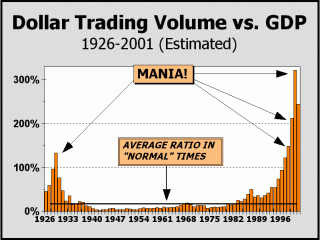
Dollar Trading Volume remains one of the clearest pictures of sentiment that we can provide. Clearly, the mania is still underway. Despite the dramatic collapse of Nasdaq, down 72% at one point, and the 39% plunge in the S&P 500, investors and speculators have maintained an extremely high rate of Dollar Trading Volume, down only 24% from last year and still an amazing 84% higher than in 1929. The "Roaring Twenties" are universally recognized as a full-fledged mania, whereas the present era is admitted only to be business as usual by the financial industry. The word "mania" is seen nowhere in print and the very suggestion of continuing madness or insanity is hushed and ridiculed. However, the extremely rapid rise and fall of Nasdaq was all the proof of a mania one needed, abetted by a chorus of professional believers who called for 6000 (!!!) when the Composite Index broke 5000. No numbers were too high. P/E multiples and dividend yields and even earnings became meaningless. Given that earnings continue to be meaningless (see Nasdaq below), there can be no question the mania remains in progress. Nothing has changed; stocks are still more important than the economy. $2.45 are still spent
on trading for every $1 spent
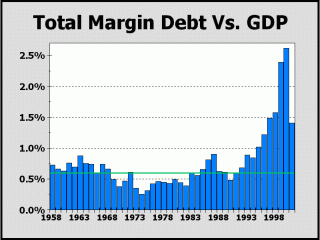
Investor's bullish sentiments can also still be seen in total margin debt compared to Gross Domestic Product. Although some readers might complain about our perspective at this juncture, we would remind that the year 2000 peak represented the peak in a veritable mania, whereas the present reading takes place within a secular bear market. Even so, the current reading of $144.7 billion in margin debt represents 1.41% of GDP, far higher than the historical average. If we were to somehow delete the mania years of 1997-2000, this year's level (incidentally, down 48% from the high) would nevertheless represent the highest reading in decades and thus, the most bullishness portrayed by investors and speculators! More importantly, this perspective equates to how both corporations and consumers have stretched their assets to accommodate the prospects for higher prices, what Professor Irving Fischer called a "permanent high plateau," at the high in 1929. Professor Fischer was as bullish as they come. So too, are investors, as today's extremely high margin debt numbers illustrate. Sentiment is clearly still as optimistic as it would be at a major bull market top.
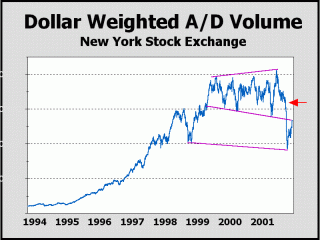
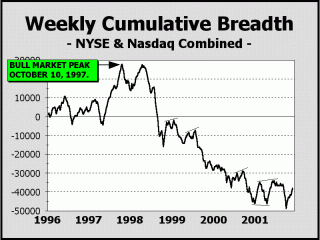
The longer term technical health of the stock market is still very much in question. Despite the obvious attraction of higher yielding issues on the New York Stock Exchange, including preffereds, utilities, and myriads of closed end funds, our dollar weighted cumulative money flow index collapsed into the September low and even ran below the 1998 low. Actually, since 1997, this measurement made no net progress into the 2001 low. The broadening top as highlighted by the rising peaks and declining bottoms, represented a period of extremely high risks and was borne out by the late summer slide in 2001. The middle line is expected to offer some resistance and even if that level falls, we would not expect this indicator to recover more than half its losses (see red arrow). Bullish analysts have pounced on the obvious improvement in breadth, totally ignoring that a vast improvement had to occur if only to relieve one of the most oversold circumstances in many years, possibly the most oversold market since the Crash of '87. Worse yet, analysts have strongly inferred the commencement of a new bull market, without the evidence that past reversals have provided with breadth thrusts. Click here for more on the definition of a breadth thrust. To date, there has been no breadth thrust and the combined cumulative weekly A/D provides zero evidence of a new bull market and instead strongly suggests the bear is still very much in control and is simply hibernating since the September clawing. Note that even several prior higher highs were met with renewed declines in breadth after the momentous peak in October 1997! The lower low into September 2001 will have to be followed by higher lows before any comfort at all can be secured. The evidence still points to an ongoing bear market....
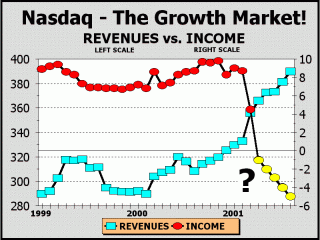
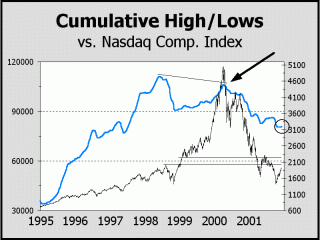
As the mania unfolded, P/E multiples and dividend yields became utterly meaningless. No wonder! Earnings were so transformed by nonsensical pro forma assumptions that they became useless prevarications. To some extent, operating earnings were also transmuted from indicating how a company's products were impacting their rate of growth to indicating how much a company was earning on its own investments (or other non-operating earnings). As in Japan in an earlier mania, "Zaitek" became the order of the day and cross-investments were made in all stripes of technology, regardless of price. As prices surged higher, companies sold profitable positions and scored increases in "income," and their shares were met by resounding cries of "buy," which only served to fuel an increase in another corporation's tech portfolio. Eventually, the mania was a house of cards and so was the economy. Corporations and consumers assumed more and more debt to fuel their demands until they could assume no more and the cycle began to fade - rapidly. By April 2001, Nasdaq's "earnings" had disappeared entirely. However, we note with great interest that revenues continue to rise, up 26.5% from a year earlier! Have some revenues become pro-forma? Consider this excerpt from the November 5th issue of Crosscurrents. "As for proof that the mania is still in place, one need only note that prices are still at valuations never seen before. But there is more proof as well. Centuries ago, in another bubble where the realities of commerce were suspended in favor of the fantasies of greed, a company was brought public "for a pursuit of great import, but no one to know what it is." We kid you not. It really happened. And those who continue to doubt the veracity of another, but greater stock market mania would be well advised to study the phenomenon of 360Networks, a Canadian company that recently accomplished the impossible, a singularly unique circumstance that could only occur in the midst of universal madness. What did fiber optic telecoms network builder360Networks do? They managed to record $63 million in NEGATIVE revenues for the 2nd Quarter, after the renegotiation of contracts forced the company to reverse the recording of $102 million of revenues already on its books. If a circumstance such as this has occurred before, we are not aware of same, and we would point out that as a culminating example of the current era of madness, this particular example is perfect. The illusion of revenues where revenues were not, enabled the shares to trade as high as $30. They now change hands at $0.12, down a mere 99.6% from the peak. Obviously, the revenues recorded were book entries only, another instance of pro-forma nonsense. We present this anomaly in our continued effort to carefully illustrate just how bogus corporate reports of operations have become. Until pro-forma reporting of all types are prohibited, this will continue to be a circumstance of public be damned and impossibilities to be determined at a later date." Please note: the losses for the months highlighted in yellow are not actual, just a "What if?" Nasdaq has stopped reporting the earnings/losses entirely and has even deleted the category that used to be available for each month's report. Proof that the great bull market mania was concluding was illustrated by our chart of Nasdaq's cumulative highs/lows, a picture we featured several times in our newsletter. The negative divergence between price and cumulative highs was as startling as any we have seen in decades. When cumulative highs peaked on May 15, 1998, the Nasdaq Composite was 1847. The Composite peaked at 5048 on March 10, 2001, a 173.3% increase, yet cumulative highs were far below the 1998 peak. How could this possibly occur? Without any doubt, Nasdaq's phenomenal rise was led by fewer and fewer issues. Note also that the recent 39.4% rally has met with nearly zero improvement in cumulative highs! As before, the mania is intact and Nasdaq's rise is fueled by very few issues. A few superstars, still down significantly in price from their 2000 peaks, do not make a bull market. As Nasdaq's recent rally shows,
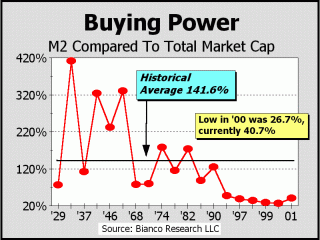
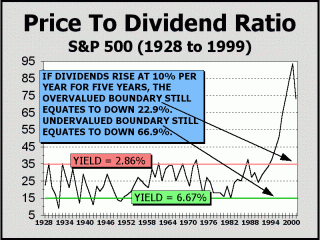
As more and more money goes into stocks, logic dictates that less and less money must remain available for other purposes, such as consumer purchases of durables and other goods and services. From the start of the bull market in October of 1990 until June of 2001, equity mutual funds recorded $1.67 trillion in net inflows. Naturally, this enormous shift of resources resulted in a significant boost in stock prices, but it may have also had an impact on the economy, as stocks became far more important to consumers than any other aspect of their lives. Clearly, DTV illustrates how important stocks became. As well, at some point, it can be argued that the reservoir of sidelined money became so small in comparison to the value of equities that something had to give. And now that the economy is likely sliding into the throes of a recession, the Federal Reserve has acted forcefully to halt that slide by lowering short term interest rates. To boot, the FRB has been inflating the supply of money for quite awhile! Over the course of the last year (September-to-September) M2 has risen at 10.9% and M3 has risen at 12.3%. And over the course of the last three months, M2 has exploded by an annualized rate of 15.1%. Given the significant decline in stock prices over the last year, the combination of much higher money supply numbers and lower stock prices makes the current M2/Market Cap reading of 40.7% on our chart all the more remarkable. Suffice it to point out that the lows achieved in August 1929, November 1968 and December 1972 were benchmarks, never exceeded until the current mania commenced. If we were to extrapolate the measurement returning to the 1990 high point in five years with M2 expanding at 10% per year, stocks would still decline by 11.6%! Until the mania commenced, the ratio of price-to-dividends provided one of the most reliable long term indicators of overvaluation and undervaluation for stocks. An investor with a long term horizon could very simply make a fortune by investing when yields were high and finally selling when yields were low. But of course, the mania changed all that and we have been told that dividends are unimportant. However, the longer equity prices remain
subdued,
Corporations were very quick to react as prices rose steadily during the mania and instead of paying dividends, were content to use their cash to purchase their own shares and other corporations' shares. However, as the bear market unfolds, we should expect investors to demand a return on their investments. If they cannot acquire that return via capital gains, corporations will again be persuaded to pay dividends and to raise dividend payouts to shareholders. Our picture below right even assumes that dividend payouts will rise 10% per year for the next five years! Even favorable scenarios seem to imply lower prices ahead!
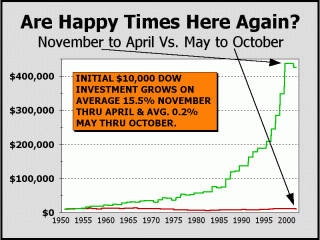
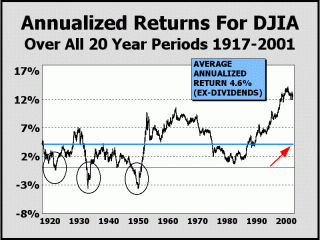
How often must we suffer the drivel of James K. Glassman? In a recent Washington Post article, Mr. Glassman once again proclaims, "The Trouble With 'Timing': It Doesn't Work." Nonsense! Of course it does. The simple proof, that Mr. Glassman and others of his ilk have totally ignored for years, we present for the umpteenth time below left. For more than a half century, one need only buy stocks on the last day of October and sell them the last of April to average a 15.5% return ex-dividends. On the other hand, Holding stocks from the first day of May to the last day of October has brought virtually no gain over the course of 51 years!!! Glassman notes, "The reason for the failure of market timing can be summed up in two words: 'random walk.' The phrase, made popular 30 years ago by Burton Malkiel, a Princeton economist, describes the pattern that stock prices take in the short term. It's random: You can't guess it; no one can." If the pattern shown in our picture below left is random, I will eat my website. The stock market can be timed! Whether this particular November-to-April period will bring its typical good fortune is another matter, though. There have been two sets of two consecutive years in which returns were negative, 1969-1970 and 1973-1974. The current period most closely resembles 1973-1974 when the Dow fell 3.6% and 12.5% respectively. We believe there is a substantial possibility that the period into April 2002 could resemble the six months leading into April 1974 - down. Down from what levels, of course, is another story. It may be that stocks rally into December and collapse into April, affording a similar resolution to 1974. However, the consistency of this seasonal effect does indeed leave us somewhat less bearish than before on the intermediate term and we suspect the greater portion of the downside in 2002 will once again come during the dismal months of May to October. Perhaps you caught the recent Peter Lynch commercials for Fidelity? You know, the one where he says. "Historically, the stock market has been a good place to be over every twenty year period." Hmmmm. Our long term study below right would seem to suggest that even twenty year periods are not all they're cracked up to be. Despite the assumption that stocks are the only place to be over the long term, there are protracted periods in which prices fall. Given an inevitable end to the mania, we would expect the twenty year return to eventually fall to more normal levels at some point in time. We are not looking for a fall into negative territory such as the three circled phases. Indeed, let's only assume a return to the same levels seen at the TOP in 1929 and again at the TOP in 1972, 6.87% and 6.77% respectively. Given that an even 7% represents better than history has afforded by half, let's use 7%. For stocks to achieve a twenty-year return of 7% in three years, the Dow would fall to precisely 4500. But why just three years? A longer period would necessarily result in a less rapid and shallower decline. Since we believe this is the eventual outcome of the secular bear market, fine by us. For the twenty-year return to slide to 7% in five years, the Dow would need to fall to 7460 and this is our approximate long term view at this point. We expect the Dow to trade down to at least 7460 at some point in the next five years (this is actually a best case scenario). Even if the decline to normal takes a full decade from now, the Dow will still be no higher than 11200, still 4.7% LOWER than the all-time print high of 11750 recorded on January 14, 2000! The long term offers no guarantee other than the passage of time.
In conclusion, we believe both the bear market AND the mania are still in progress. As before, investors continue to believe in the power of Nasdaq's ability to generate riches. As before, participants believe one should always be fully invested. As John Huffman has just pointed out in a November 20th update, the level of strategist's bullishness equates to a loss of 25% in the year ahead. Manias die hard.
We invite you to stay tuned for our next report, in which we will take our first look at the year ahead in 2002. Our plans also call for a few perspectives on equity mutual funds which have only appeared in our newsletter and nowhere else. As shown below, we hit our targets for 2001. The September 21st low was very likely the low for the year. At this juncture, we see a decline to no worse than SPX 1060 for the remainder of the year and we believe the SPX could trade as high as 1249 (1177 much more likely) before the end of the year. Our downside targets
for 2001 were as follows:
The closing lows thus
far were:
Thank you for viewing this site, which is usually targeted for an update approximately every six to seven weeks. Since we will be away for the Christmas holidays, we do not expect to be able to update next until the second week of January 2002, but our home page will post the expected date of posting within a week of the actual update. We urge you to stay tuned and to tell your friends. In the meantime, please be our guest and return to the other sections of our site to view the updates of our other features. If you haven't seen them before, the Commentary, Chart of the Week and Short Term Outlook pages should be of further interest. We are considering implementing new features as well (possibly for subscribers only). Your input is always appreciated. I hope you have enjoyed your visit and please return again. If you know anyone who might be interested in seeing what we have to offer, we'd be happy to have them visit as well! Alan M. Newman, November 20, 2001
All information on this website is prepared from data obtained from sources believed reliable, but not guaranteed by us, and is not considered to be all inclusive. Any stocks, sectors or indexes mentioned on this page are not to be construed as buy, sell, hold or short recommendations. This report is for informational and entertainment purposes only. Longboat Global Advisors, Alan M. Newman and or a member of Mr. Newman’s family may be long or short the securities or related options or other derivative securities mentioned in this report. Our perspectives are subject to change without notice. We assume no responsibility or liability for the information contained in this report. No investment or trading advice whatsoever is implied by our commentary, coverage or charts. |