|
MOST CHART DATA THROUGH MAY 24, 2001 A SPECIAL REPORT BY ALAN M. NEWMAN, EDITOR LONGBOAT GLOBAL ADVISORS CROSSCURRENTS |
| The dream lives on.
The "re-ignition" since the March bottom proves only that most particpants are still bullish on the stock market, despite the apparent continuing weakness in the U.S. economy. In the same manner that the decline in the economy from last year's highs was not foreseen, it is very likely that continued weakness from this point is not now foreseen. And despite the good intentions of the Federal Reserve, we do not believe the business cycle has been nor can be repealed. Most importantly, we cannot see how one can repeal the secular cycles of stock ownership. From 1974 to 1982, most Americans swore off stocks and were content with conservative investments that could not lose their value (yet still did in inflation-adjusted terms, only more slowly than stocks). The secular bull market drew 50% of U.S. households in before the top, the largest participation in history. But investors in recent years are losing money. The longer they remain losers, the more likely the bear is to resume in earnest. Given the relative full exposure by Wall Street Stragegists to stocks and still low mutual fund cash levels, the bear market should resume soon. We expect stocks to
continue to underperform
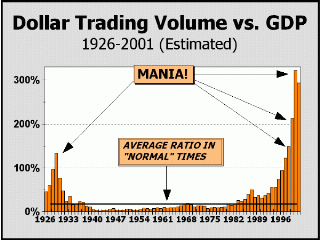
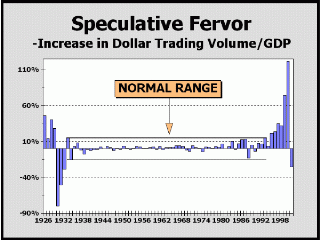
The more we look at Dollar Trading Volume, the more we are convinced the mania of 1995-2001 has been the greatest stock market mania of all time, surpassing even the manic activity of the South Sea Bubble and the Roaring Twenties. From literally every aspect we explore, we find that past benchmarks have been exceeded, in many cases by a wide margin. DTV itself is one such benchmark, proof in our eyes that the stock market has very much become the U.S. economy. Given the actions and written comments of the Federal Reserve since the interest rate cuts commenced in January, there can be no doubt that the Fed sees a threat too large to ignore ("....the possible effects of earlier reductions in equity wealth on consumption.....continues to weigh on the economy"). Clearly, the chart of DTV shows that the Roaring Twenties were no comparison to the "traffic" generated in the current mania. Given that the "traffic" itself is now a multiple of the entire gross domestic product of the economy, it is easy to infer that the stock market has truly become the linchpin of the economy. This month, we have decided to replace our traditional view of DTV vs. total market capitalization with a new view, equally incredible. To better measure the annual increase in speculative fervor, we have divided the annual increase in total DTV by GDP. In this manner, we believe the annual changes in overall speculative activity are better represented. As seen below, the annual increases in activity measured nearly half of total GDP a lifetime ago. In the current mania, the increase in activity in 1999 and 2000 went far beyond the Roaring Twenties. In 2000, the annual increase in Dollar Trading Volume actually exceeded total GDP by 21%! What is of particular note is that most of our chart appears quite empty, showing only the few years of the Roaring Twenties and the current mania as "filled" and "abnormal" space. What passed for normal was a continuous period of 62 years, from 1933 to 1994, in which activity was only a small fraction of manic times. That so long a period could elapse without the spikes present during the Roaring Twenties or the present, speaks volumes about the abnormality of the present mania. But is anyone listening? The evidence presented by the mania is both striking and OBVIOUS.
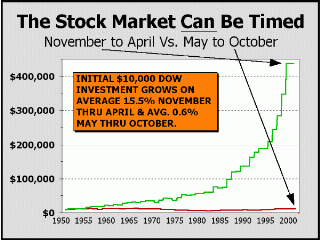
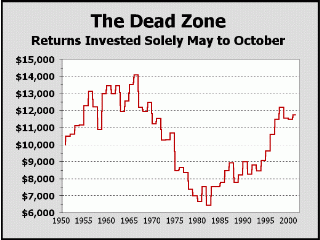
We are presenting a portion of our article in the May 7th issue of Crosscurrents, dealing with market timing. The original concept was discovered years ago and is the result of research by Yale Hirsch and Sy Harding. For the last 51 years, the stock market could have been timed! The timing "system" is effective with only two simple investment decisions each year. For more than 50 years, the methodology has produced superior and virtually unmatchable gains, further proof that any spin devised by Wall Street pros is utterly useless in the long run. As our chart at bottom left clearly illustrates, an initial investment of $10,000 in 1950 has grown to $426,227 in the months of November to April. The methodology sells the Dow Industrials at the close of trading every April and buys the Dow at the end of each October. Conversely, the same $10,000 invested in only the months of May through October has grown to a paltry $11,750! Hardly worth the effort or risk, no? The six month gains from November through April average 15.5%, so far in excess of the market's own historical record that one wonders why Wall Street strategists are as widely followed as they are! Incredibly, returns for the May to October "Dead Zone" (chart below right) actually peaked 36 years ago in October of 1965 and an investor exposed solely to this six month period since that time would have lost 16.6% of his original investment. It is with some measure of disdain for Wall Street's spinmeisters that we reveal the absolute best consecutive ten year stretch for the months May through October (1988 to 1998) has averaged less than 4.6% annually! Seems one have needed only to consult a calendar and make a grand total of two investment decisions each year since 1950 to outperform Wall Street's pros by a very wide margin. Of course, there are no guarantees that the methodology will work forever. Despite the obvious caveat that this methodology may not even work this year, we believe the stage is set for another stock market decline into the end of October. Even in the last four years of the greatest stock market mania of all time, the May to October "Dead Zone" has produced total annualized gains of a mere 2.3%, less than half the historical norm and way, way below investor's expectations. Only 21 days into May 2001, the Dow has produced a gain of 5.6%, already well in excess of what we might expect on average during the "Dead Zone." Since history has shown May to October to be a bummer, this particular May to October - at the tail end of the greatest stock market mania of all time - should find the bear market alive and well. Even when measured from the 1982 bottom,
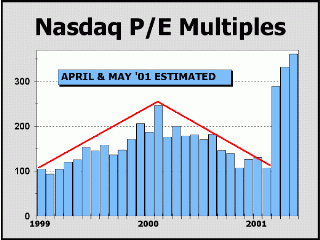
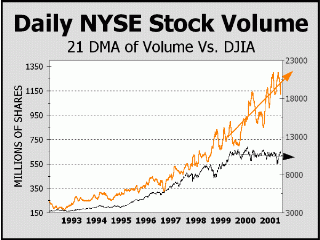
Nasdaq has only released information through March, so we have estimated P/E's for the months of April and May, based on the same levels of income registered in March and increased share prices. Given the pattern of declining net income in the first three months of the year (down an astounding 50%), we believe our estimates are probably not too far off the mark. The Nasdaq pyramid we have drawn on several occasions simply shows how investors and speculators get sucked in on the way up only to suffer as prices subsequently collapse. Incredibly, the pyramid appears to be forming once more but at vastly higher levels than before. At today's high, we estimate the overall P/E for Nasdaq was 361, 47% higher than last year's February high of 245! Nasdaq represents a leap of immense faith for investors and speculators at this juncture. If one were buying for an expected annual price gain of 20% predicated on a DOUBLING of Nasdaq earnings, one would STILL be facing an overall P/E of 217 next May. It is commonly believed that a bull market thrives on an expansion of volume (the theory being that increased volume represents increased demand). However, at its essence, volume simply represents turnover and not necessarily accumulation. Below, we see how steadily increased volume on the NYSE over a two year period has had absolutely no influence on price. In our view, if anything, the higher volume may represent supply and distribution instead of demand and accumulation! Volume increased by two-thirds while the Dow has traded sideways to lower. What kind of volume increases will be needed to push the Dow into unchartered territory well above last year's highs? Given the already huge exposure of Americans to stocks and the overwhelming bullishness of strategists, can a substantial increase in volume even occur? These pictures represent blind faith, not a "re-ignition" of the bull market.
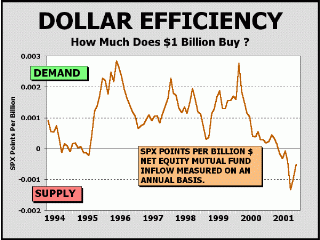
Since our previous update, these two pictures have actually deteriorated. The cost of the average dollar invested in the S&P 500 has risen to 1407, still 7% higher than last Tuesday's print highs. Given how a mania works, most of the money that is drawn into the game is drawn late in the game, when prices are at their highs and the lure is irresistible. More than $520 BILLION in net inflows entered the stock market in the years 1999 to 2000, yet before the year 2000 had ended, investors that had entered the market in that period of time were still behind! How does that work?! The biggest net inflows in history (by far) cannot support prices? Truly, truly amazing. As we see next, money goes so far and can go no further. When prices are too high, no amount of money can buy price improvement. Even after a stunning 21.6% rally off the March 2001 lows, annual Dollar Efficiency for the S&P 500 remains negative. [EDNOTE: OUR CHARTS ASSUME A $10 BILLION INFLOW FOR APRIL AND A $15 BILLION INFLOW FOR MAY WITH MAY CLOSING AT SPX 1315). The belief that a re-ignition phase is taking place runs counter to the evidence that shows investors are likely to be growing very impatient with losses and the inability of invested monies to buy sufficient price improvement to bring them back to a level consistent with profits. What will happen if investor patience finally runs out?
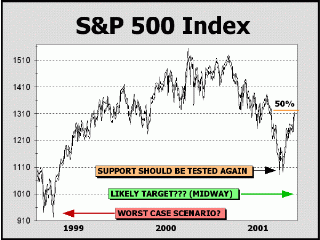
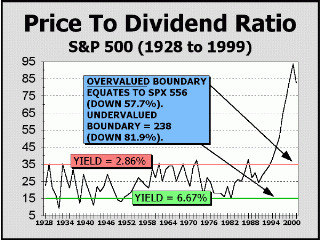
Thus far, our Dow "potential" target was exceeded by 3% and our SPX target was penetrated by 2.1%. Our Nasdaq potential target was not exceeded. However, we were clearly wrong about last month's action and have had to update our views on the chart at bottom left and are offering new projections (further below). The rally was far stronger than we envisioned, but we certainly do not see the nascent bull market or "re-ignition" much of Wall Street would have you believe is now in force. We do see blind faith. Typically, prices rise as sentiment turns bullish and this time has been no exception. From continued increases in strategist's allocations to stocks, to investment advisers returning to a 50% bullish position, to the return of positive mutual find inflows (albeit far below record setting pace), to large speculators again accumulating larger positions in the S&P futures, we see sentiment as having turned extremely bullish in recent days. This should result in a correction soon and perhaps a test of the March lows. In fact, a successful test of these lows might even turn us bullish for the summer. The odds favor strong resistance short term at SPX 1317 (50% between last year's high print of 1553 and this year's low print of 1071). However, even if that resistance is penetrated, we can still easily make the long term bear case and do not expect to turn more than short term bullish at any point. Bear in mind, our CROSSCURRENTS newsletter is almost always both long and short and attempts to be as market neutral as the circumstances permit. However, with respect to momentum, it is probably correct to alter our forecasts. Our worst case scenario for the remainder of the year would see a test of the 1998 lows, down around SPX 923. More likely, a viable target resides somewhere between our worst case and the nominal test of the March lows of 1081 print basis. This "likely" target would take the SPX to approximately 1002. Over the long term, despite the protestations of those who espouse the new economy, it should be evident that the 70% crash in Nasdaq prices has told us a far different story. The good times were discounted as much as a decade away at last year's highs and are still likely discounted years out. Businesses cannot be worth more when earnings decline, and the current environment will probably produce far lower expectations at some point. We have already experienced the longest peacetime expansion in our history and the boom times have driven both personal and corporate debt levels to extremes that cannot be sustained. Simply put, a contraction in economic activity at this point is logical. The savings rate for Americans has turned negative as speculation has increased and incidentally, as dividends have disappeared. At some point, we must expect the savings rate to turn positive once again and as it does, we believe dividends will once again become important to investors. Perhaps it is far too pessimistic to consider an eventual return to historical undervalued levels, but a return to what were formerly OVERVALUED levels should be attainable someday. The formerly "overvalued" boundary now lies at SPX 556, down nearly 58% from today's prices and down more than 64% from last year's peak. Despite the call for higher prices, lower
prices are likely,
In our last report, we mentioned that "There is no greater killer of bull markets than volatility." Although volatility has clearly contracted in recent weeks, the contraction appears due to Federal Reserve Board moves to restore confidence in stocks and subsequently, to bolster the economy. As we have already observed, the stock market IS for all intents and purposes, THE ECONOMY and cannot be allowed to fail with personal and corporate debt levels so high. As a result, the FRB has embarked upon their own phase of volatility, reducing short term interest rates at the most rapid pace in history. The Fed overeacted in 1998 and gave us an asset bubble like none the world has ever seen. The Fed may be overeacting again and in doing so, threatens to reignite the mania. We admit to reflecting on the odds that the mania can be reignited. Given the "Greenspan Put," the tax cut and the possibility that the Bush administration may eventually find the backing for a plan to invest Social Security funds in stocks, we believe a reignition of the mania could conceivably take place. But in the long run, the "Put" must fail since higher prices cannot be guaranteed indefinitely. As well, most of Social Security's assets are government's IOUs to begin with, so any stock purchases made by the Treasury would be the equivalent of buying on margin. We shudder to think of a resolution wherein an eventual "margin call" erases any short term beneficial effects derived from this plan. History has shown that government efforts to invest in the private sector have invariably failed. In the final analysis, stocks can only be
valued on the earnings
Our downside targets for
the remainder of 2001 are:
Our "best case" upside
target potentials for the remainder of 2001 are as follows:
Alan M. Newman, May 25, 2001
All information on this website is prepared from data obtained from sources believed reliable, but not guaranteed by us, and is not considered to be all inclusive. Any stocks, sectors or indexes mentioned on this page are not to be construed as buy, sell, hold or short recommendations. This report is for informational and entertainment purposes only. Longboat Global Advisors, Alan M. Newman and or a member of Mr. Newman’s family may be long or short the securities or related options or other derivative securities mentioned in this report. Our perspectives are subject to change without notice. We assume no responsibility or liability for the information contained in this report. No investment or trading advice whatsoever is implied by our commentary, coverage or charts. |