|
CHART DATA AS OF JUNE 12, 2002 A SPECIAL REPORT BY ALAN M. NEWMAN, EDITOR LONGBOAT GLOBAL ADVISORS CROSSCURRENTS |
| Bulls claim that the move
to the September 2001 lows represented a true "panic" low and that action
since has been a bull market. We would be amongst the first to buy
a true "capitulation" bottom, but in our views, the September lows were
something quite different. First of all, the Dow peak came on May
18th at 11350 (print basis). By September 10th, the Dow was down
as low as 9493, a 16.4% move that to s
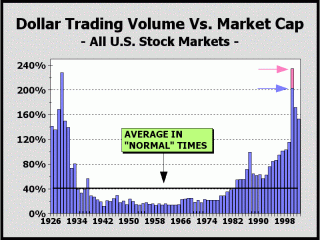
Although Dollar Trading Volume has subsided considerably from the 2000 peak, the pace of dollars transacted in stocks remains at levels consistent with a full fledged stock market mania, and indeed is 50% higher than in 1929. The public has clearly begun to withdraw from the arena but mutual funds have not. The industry is desperate to prove itself and much of the velocity of trading is now catalyzed by only 75 mutual funds that account for 44% of the entire U.S. stock market. Sector rotation, wholesale dumping of disappointing issues, accumulation of new "sizzle" stories and the like continue to fuel aspirations, if not prices. In fact, rotation from large overcapitalized issues where prices could not possibly be sustained, into smaller capitalized issues, promoted a bull market in smaller stocks. Mutual fund focus on this sector is now cited as proof that one should always be invested, that one can always make money in the stock market. After the bizarre and unconscionable errors of judgment made by mutuals in the past three years, we are happy to maintain our stance that one should NOT be invested in stocks at ALL times (see the Dead Zone below). Even today, for every dollar spent on the purchase of goods and services throughout the economy, $1.91 are spent on trading. Given that prices peaked 27 months ago and are actually below where they were as far back as February 1998 (52 months ago), there can be no question that hope resides in extremely large quantities for investors. This is a most unusual development, a first in stock market history, where investors continue to "hang in" despite lower and lower prices. Perhaps the most cogent reason for this hope is the parade of bullish analysts and money managers in financial magazines and especially, on CNBC, where the impact of the one-minute sound bite has it's most dramatic impact. Although the bear views of luminaries such as Sir John Templeton have been on display a couple of times in recent months, we still see a paucity of those correctly committed to the bear case for equities, particularly those who have been so eloquent and so correct for several years, like David Tice of the Prudent Bear fund and like Charles Minter of Comstock Funds. It is duly noted that CNBC has presented more of the bear case in recent months, but why did it take so long? Why is the bear case still not given equal time with the bull case that is reiterated time and time again to the disadvantage of viewers, CNBC's own customers?! DTV in terms of total stock market cap has fallen significantly. What is important to note is the extended pink bar which illustrates where this indicator stood as trading peaked in March of 2000. The purple bar measures the year end value. Amazingly, even here the present mania places 1929 in a lesser light. Although we have not analyzed weekly or monthly volumes to determine if the 1929 measure surged any higher at the peak, we believe it probably did not. First of all, the peak occurred later in the year and volume picked up substantially as the market crashed. Thus, we have no doubt that the 2000 peak exceeded the 1929 peak. And although trading has subsided considerably for this measure, today's pattern is still a close match and offers an inference that the measure has a long way to go on the downside. Sans the prior and present manic periods, the average for this measure is 40%. Even when we include the manic periods, the average is 46%. DTV is still 153% of total market capitalization.
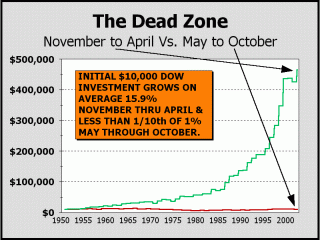
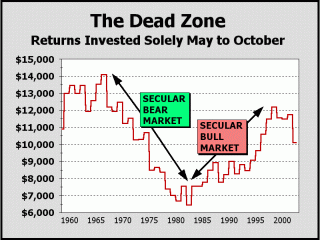
Much of the following commentary appeared in the April 29th issue of Crosscurrents. We feel it is important for us to reiterate these views and disseminate this article as widely as possible. For the last few years, we have commented upon seasonal effects, calling the May to October period the Dead Zone. Throughout the period covering 1950 to the present day, virtually all of the stock markets gains have come in the period November through April, and virtually none from May to October. In fact, $10,000 invested for just the months of November to April would have grown to $465,472 since 1950. The same $10,000 invested solely from May through October would have gained less than $115! Several reasons have been advanced for the strange seasonal behavior of stock prices and they do make sense. One is that year end bonuses are anticipated and acted upon late in the year and other bonuses are paid out early in the new year and are then invested. Plus, the arrival of tax season brings the IRA deadline into view and investments are compressed into a short time frame. Clearly, the cause for the effects go beyond these simple explanations since our chart dates back more than a half century. But whatever the causes are, they are readily visible in the effect. Given our perspective that we are likely in the midst of what will turn out to be the worst bear market of our lifetimes, we expect the upcoming May to October period to under perform the average May to October time frame by a wide margin. We still believe that bullish sentiment is the stock market's biggest enemy. Simply put, the Dow has come back so often and so quickly from the precipice since 1987 that folks truly believe that all is required is a few moments of patience for profits to reappear. The favorable November to April stretch has witnessed only two episodes where prices fell by more than 10%. However, the Dead Zone has accommodated nine such periods, the last of which was last year. Although back-to-back Dead Zone periods of worse than 10% losses have yet to occur, we believe the scene is now set for such a circumstance. As our next chart shows, there is a clear distinction between secular bull and bear phases for the Dead Zone. If the current bear market plays out anywhere near like it did from 1966-1982, the Dead Zone will provide a very costly experience for investors. And in reality, the results are far worse than they appear here. Monies invested solely during the Dead Zone from 1966-1982 fell by a resounding 54.2% but that was before the effects of inflation. With inflation factored in, the constant dollar loss was a whopping 84.6%! Consider that when the folks on Wall Street tell you to be invested all year round.
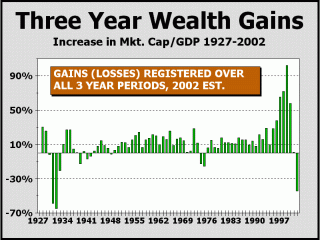
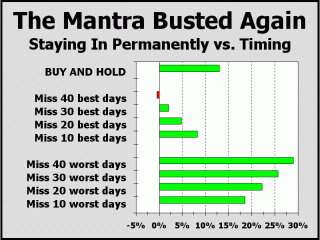
While we are on the subject on stock market timing, we should note that professionals advice to "stay the course" has placed investors in their worst position for any three year period since the Roaring Twenties bust collapsed prices by 90%. The shock registered after the prior mania surged as high as 58.7% of GDP and was probably one of the primary drivers of the depression. However, it has always been our contention that the present "bust" represented a period that was quite likely to be worse than the severe declines of 1973-1974 but not as calamitous as the depression brought on by the last true mania. That still appears to be the case. If a worse scenario is in the cards, it is not yet visible. What stands out for us as observers is that the American investors' trust in venerable institutions has been crushed by the mania. Earnings were not what they were touted to be. Corporate insiders conspired to reap gains at the expense of their own shareholders. Financial firms betrayed their customers' trust. At many levels, there was collusion and there was a patent acceptance of the course of business that implied no end to the rise in prices. The three year decline now equates to more than $4.6 trillion, 44% of GDP. The damage is quite enough to catalyze a long term shift by investors out of stocks and into assets perceived as less risky. Professionals advice to "stay the course" typically cites the math that shows missing just a few of the best days results in inferior long term performance. It has always been our stance that the math shown is a sales tool expressly designed to keep investors attracted to stocks and to convince them to invest more. The math shown is correct, but is a false perspective, a mathematical construct with no legitimate value. What is readily apparent is that the opposite tack is far more profitable; avoid stocks at all costs when they are at their worst! Incredibly, the mantra is repeated in print every so often, by money managers, by the media and by mutual funds themselves. The proof is on this page..... Not only can the stock market be timed, it should be timed.
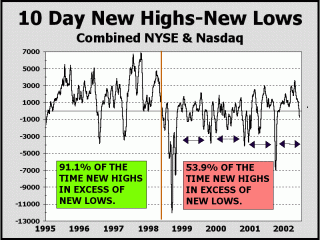
Our favorite perspectives are those that combine the two major U.S. exchanges, the NYSE and Nasdaq. We can understand focusing on one or the other depending upon the point to be made but if the combined views are ignored entirely, perspectives must necessarily be skewed. There are two factors that jump out at us when viewing the chart of 10-day new highs minus new lows for the combined exchanges. First, as we have shown before, there are two distinct phases; the bull market and the bear market. Dynamics through the spring of 1998 were readily apparent and illustrated an extremely broad and sustained advance by the U.S. stock market. Since that point, advances have been staccato, rather than sustained. Despite the recent advance to the highest peak since 1998, we see no evidence that the cycle has shifted back to the bull's favor. In fact, what has become more evident is the cycle between lows! The indicator has now fallen to below zero and suggests that this particular cycle low is still some time away. The average cycle seems to be about a year and would ideally place the next low in late September of 2002. Cumulative Advance/Decline Volume for the combined
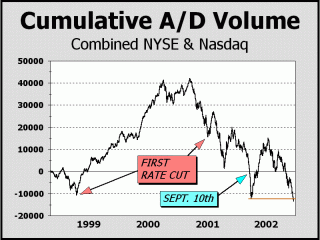
U.S. markets has been the scariest chart we have been able to muster for
many months. More than anywhere else, we see the true character of
the U.S. stock market, under constant pressure (distribution) since March
27, 2000. The slight break above of the March high on September 1st
was, in retrospect, a huge double top and not a brave new world.
The rate cut in 1998 not only saved the markets from the LTCM disaster,
but catalyzed the final stages of the mania by convincing investors that
the Fed would not allow the market to fail under any circumstances.
Widely acknowledged as the "Greenspan Put," the subsequent series of rate
cuts commencing in January 2001 convinced investors to remain aboard stocks.
Eleven rate cuts have not changed the direction, the first time in market
history that Fed accommodation has been meaningless. Incredibly,
even as this indicator remained below the September 10, 2001 level, the
chorus of analysts proclaiming a brand new bull market grew and grew.
And even today, as the indicator has plunged below the September 27th panic
low, most of what we see and hear in the financial media is "you gotta
buy 'em!"
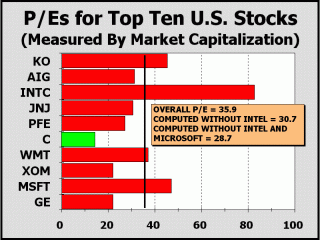
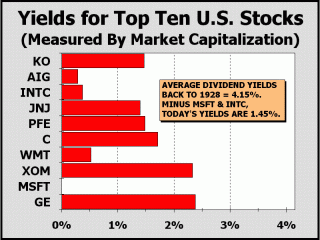
The S&P 500 are still down 32.4% from their all time highs. Perhaps now they are fairly valued? Perhaps they are not. The S&P 500 represent 78% of the entire U.S. stock market. The ten largest of those issues represent 22.5% of the S&P and nearly 18% of the entire U.S. stock market. Although we must certainly admit that some pockets of under valuation may now exist, the S&P index is still largely overvalued by a wide margin. Much of the poor valuations have been accomplished by the move to index entire portfolios, probably one of the worst ideas ever set forth by financial management firms. Vanguard's John Bogle touted indexing over the years as the most reasonable way for investors to play the market (and incidentally, to forget about timing same). Bogle's arguments for "passive management" became so convincing over the years that Vanguard's S&P index fund became the favored vehicle of retirement plans both private and public and spawned similar products from virtually all of the major mutual funds. S&P's franchise grew so popular that the keepers of the flame felt obliged to offer the best possible performance by adjusting the index from time to time. So ironically, as information technology issues began to scream to the upside, "passive management" became active management and the S&P wound up changing the very character of the index by shifting assets our of staid and stodgy non performers and into riskier moonshots. Since 1994, there have been 293 changes, amounting to 59% of the entire index. Since the index is capitalization weighted, more money goes into the issues with higher capitalization. Incredibly, in this manner, index funds wound up plunging more money into stocks at unsustainable peaks, such as Worldcom, Global Crossing and Enron. Worse yet, the issues were kept by management down 95% from their highs before they were lopped off the roster. In our experience, you would have to be dead to manage money worse than the managers of S&P did. And now, the index stands so far away from past benchmarks that it may take years to recover. The top ten issues pictured here today are the lion's share of the entire U.S. stock market and are ample evidence that despite the many changes, overvaluation is not confined to just technology issues. Even without computing the extremely high P/E ratios of Microsoft and Intel, average P/Es are 50% to 100% higher than one might expect in "normal" times. Dividend yields are also far below "normal" at 1.20% for our super group. For comparison's sake, the chart extends out to the average Dow yield back to 1928, to be precise 4.15%. Even the highest of the dividend yields we show on this chart is far below "average." If dividends were to grow at 10% per year for the next five years, based on the historical average, prices could fall another 54%! Finally, although we are not showing a chart of Price-to-book values, the ratio is 6.2, still as high as it has ever been for components thought to represent the world's largest and best stock market. The S&P 500 remain far from fairly valued.
Back in pre-mania days, when professionals were able to admit to occasional bad times, markets were able to turn from bear to bull. Sentiment has always been a driver of price. Too many bulls? The players have all bought and prices can only reverse and fall. Too many bears? The players have all sold and prices can only reverse and rise. In the present circumstance, the mania impacted the population like never before. At the peak, 52% of household assets were in stocks, up from about 18% in 1982. Virtually everyone was aboard. For the most part today, even as stocks under perform most other asset classes, professionals continue to pound the table for the bull case. Selling has been orderly and consistent. But sans a capitulation in sentiment, there can be no capitulation or end to the selling. On December 30, 1974, John J. McElroy III of Drexel Burnham was quoted, "We don't see any imminent rise in stock prices." On August 18, 1982, Alfred E. Goldman of AG Edwards & Sons said, "Normally, news doesn't reverse a major trend, and we believe the trend is still down." On November 29, 1987, Steven G. Einhorn of Goldman, Sachs said, "The market doesn't have the ability and/or the strength to sustain an advance from current levels." All of these pronouncement came within days of major bottoms and were one voice of many at the time. As long as strategists and advisers maintain their current bullish prognostications, the present bear market will endure. Clearly, the voices of the past have been silenced. The bear case simply does not get equal time! Only time will tell.....
A small portion of the charts and analysis presented here are shown in our newsletter weeks and months in advance of their appearance on this site. If you haven't already, we urge you to take advantage of our FREE 3-issue trial (see link below). We hit our targets for both 2000 and for 2001. Months ago, we offered a forecast that "The September 21st low was very likely the low for the year [2001]....we believe the SPX could trade as high as 1249 (1177 much more likely) before the end of the year." We pretty much nailed the top print which came in at SPX 1173.62 on December 5th and actually called for a December 6th high in our newsletter. As it turns out, the high since the September low has been 1176.97 registered on January 7th, only .03 from the "much more likely" high we had initially pegged. We have made some minor adjustments in our targets. Downside odds have actually been lowered very slightly, but Nasdaq's downside target is even lower than before. Upside "potential" targets have been lowered slightly by giving them a "range." The bottom ends of those ranges appear to be far more likely at this point than the upper end of the ranges. Our downside targets
for 2002 are as follows (2 in 3 odds):
Our best case scenario
for 2002 is as follows (very low probability):
Alan M. Newman, June 12, 2002
All information on this website is prepared from data obtained from sources believed reliable, but not guaranteed by us, and is not considered to be all inclusive. Any stocks, sectors or indexes mentioned on this page are not to be construed as buy, sell, hold or short recommendations. This report is for informational and entertainment purposes only. Longboat Global Advisors, Alan M. Newman and or a member of Mr. Newman’s family may be long or short the securities or related options or other derivative securities mentioned in this report. Our perspectives are subject to change without notice. We assume no responsibility or liability for the information contained in this report. No investment or trading advice whatsoever is implied by our commentary, coverage or charts. |