|
MOST CHART DATA THROUGH FEBRUARY 23, 2001 A SPECIAL REPORT BY ALAN M. NEWMAN, EDITOR LONGBOAT GLOBAL ADVISORS CROSSCURRENTS |
| In our last look at the
mania, we said the "free 'Greenspan Put' cannot work magic forever."
Despite what Wall Street strategists are still saying, the "Put"
is looking mighty sick. There has to be a limit upon what participants
are prepared to pay for stocks, no matter how optimistic they are.
And so, some two-and-a-half years AFTER breadth and new highs peaked, we
are finally at a point where the bear market cannot be denied by any reasonable
analysis. By the "official" definition, the bear arrives (way after
the fact) when prices are already down 20% from their highs. The
S&P 500 represents 85% of total stock market capitalization and peaked
on a closing basis on March 24, 2000 at 1527.46. With the close of
Friday, February 23rd at 1245.86. the S&P 500 are now down only 18.4%
from the peak close and are still not "officially" in a bear market.
Never mind that on a print basis, the S&P have fallen 21.7%
from the March 2000 highs. The really important question is whether
Wall Street will finally wake up to what has occurred? Will Wall
Street finally admit error? Will the superstar strategists who have
hogged the CNBC platform for so long finally be cast in the lesser
light they have so richly deserved since last year's highs?
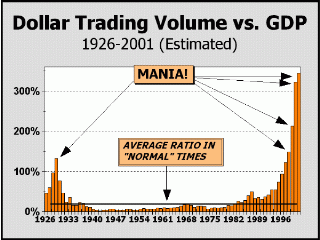
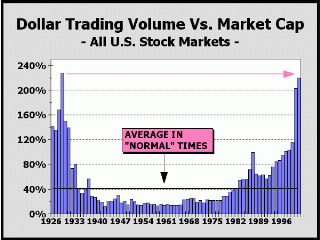
Capitulation only comes with public recognition of a bear market! Normally, we do not quote ourselves, but the following words from the February 20th issue of Crosscurrents accentuate the phenomenon so well. "On Wednesday, February 7th, Cisco Systems reacted to the prior evening's release of disappointing earnings by trading 281,300,000 shares, an unbelievable 12,000 shares for every second the trading markets were open. Total dollar volume of shares traded was approximately $8.75 billion, theoretically equating to 31.5% of all GDP generated that day. Given that retail sales are a significant portion of GDP and that one-third of these sales take place in the Christmas shopping period, Cisco's DTV compared to the actual percentage of GDP was probably much higher. Again, the stock market offered solid proof that nothing is more important than the market itself and that the stock market IS the economy. Alan Greenspan has confirmed this notion by aggressively cutting interest rates and continuing to act in the role of messiah for all things financial. However, we believe it is far more important to point out that the actions of the Federal Reserve Board got us to this place via a series of decisions that totally ignored reality and history, not only allowing but encouraging the environment for a stock market mania. The repercussions are likely to be worse than already experienced to date and could unfold over a period of several years to come. In the words of Barton Biggs, 'It still boggles my imagination that everybody thinks we can come through the biggest bubble in the history of the world and certainly the longest boom that the U.S. has ever had and get out of it with a very, very mild recession.'" In testimony before Congress last year, Greenspan opined that knowing an asset bubble beforehand was problematic, that one might only be able to see such a bubble after it had burst. All the while, for a year before and the year since, we have shown the expanding bubble in the first two charts of each update. There could never be a mistake in interpreting the comparisons with 1929. The Crash that ended the Roaring Twenties was the consequence of one of the greatest stock market manias of all time and was built on leverage. The leverage afforded consumers via the rapidly expanding use of installment plans enabled superb economic growth and higher earnings for American corporations. The leverage afforded the same consumers via the rapidly expanding use of margin loans enabled purchases of shares of American corporations in increasing size. Leverage enabled larger positions than would otherwise have been considered reasonable. When prices ran to extremes that could not be supported by the fundamentals, they collapsed. The comparisons to the present day and age are striking. Today, the leverage provided by credit cards, home equity loans, second mortgages and home mortgages with as little as 5% equity have accomplished a similar environment to the "Roaring Twenties." As a result, prices once again soared to extremes that could only (loudly!) signify an asset bubble. The charts of both Dollar Trading Volume vs. GDP and DTV versus total market capitalization could only match or exceed the former era if an asset bubble was in place. We advertised these facts. Despite a collapse in Nasdaq, despite an obvious slowdown in corporate earnings and in the economy (read recession), hope lingers and recognition hides behind the veneer of the long term mantra. Sadly, the dénouement is just beginning. Even the Chairman of the Federal Reserve didn't see a mania in progress!
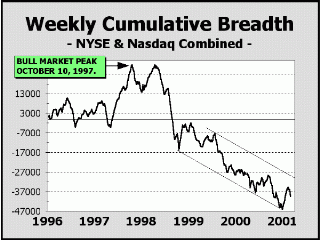
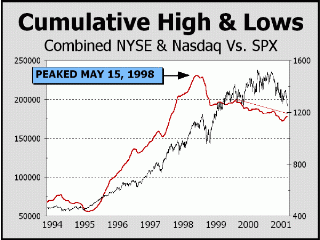
It's so easy for observers to ignore the obvious that it's a wonder that any of us gets it right at anytime. As the December-January decline ended and the indexes reversed course, analysts were very quick to pick up on improved breadth and new high/new low statistics, many of them even pushing the case of a brand new bull market. In fact, the improvements in the advance-decline line and in new high-new low numbers were destined to occur and signified nothing other than a normal countertrend move! Given our thesis of a secular and super bear market in place even as the mania unfolded for the very largest stocks and for Nasdaq's index driven momentum issues, an extraordinary length of time would be required to build a base to launch a new bull market - a base that might even require years to create. As our charts clearly show, breadth has not confirmed the presence of a new bull market. New highs & lows have not confirmed the presence of a new bull market. Both charts still illustrate a declining long term trend. Breadth clearly remains in a long term downwards sloping channel. Cumulative highs & lows remain below their long term declining trend line. Even if these lines fail to hold a springtime advance, there is no possibility we are in for a ride back to the old highs. The 1999 highs for both charts should remain inviolable. Incredibly, during the last two years of deteriorating technical and fundamental indications,we have yet to see any admission by Wall Street's big shot strategists of a bear market in progress. For Abby Joseph Cohen, Joe Battipaglia, Jeffrey Applegate and others, there has been no bear market, only continued projections for higher prices. Wall Street's market letter writers have also remained consistently upbeat, averaging over 50% bulls month after month. and even recently averaged more than 60% bulls for one four week stretch! Our simple little question: is it a bear market yet???!!!
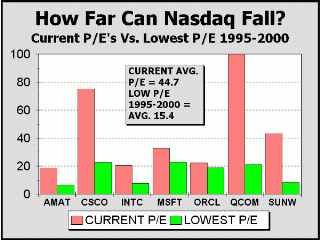
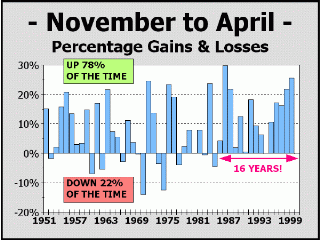
Every step of the way down, buying appears for Nasdaq's tarnished superstars. The rallies are impressive, up 4% or 5% in a day, up 10% in a week, but truth be told, 50% down followed by 50% up still leaves the overall index in the red by 25%. Repeat the exercise twice in succession and the overall index is back down by 58%, despite the punctuation of the impressive rallies! Nasdaq still trades at incredibly high P/E multiples, far higher than any recorded in any prior era. Using seven of Nasdaq's most popular issues as a guide, two of which are in the Dow Jones Industrials, we hope to afford a perspective on just how far Nasdaq can fall in price. Interestingly, we are using the period of 1995-2000 as a yardstick, during which a veritable mania was in place. The lowest average multiples suffered by our group of seven was 15.4, a resounding 65.5% under the current average of 44.7 P/E. It would be somewhat coincidental to see all seven trade at their lowest multiples all at the same time, so the 65.5% probably represents more than the maximum decline we should expect at any point in time. However, 35% or even 50% down from current levels would still represent average P/Es well above the lows of the mania and ought to present achievable price levels for the group. Price levels this low would equate to Nasdaq well under 2000, possibly well under 1500. Do we really think price levels this low are achievable? Yes. We believe the odds strongly favor a bottom now and a tradable rally into the IRA season. Part of our expectation is based on the historically dominant period of November to April to provide investors with literally 100% of all stock market gains over the last half century. You will read more on that score in our April or May update. As we see here, the period of November to April has been positive for 16 consecutive years, pretty much in line with the secular bull market that commenced in 1982. However, If the secular bull has concluded as we believe it has, even the historically strong season for stocks may finally give way to a loss. Given that the Dow ended October at 10971, even a 5% rally in the next two months will break the string! A break of a trend this pronounced will likely signify a sea change in progress.
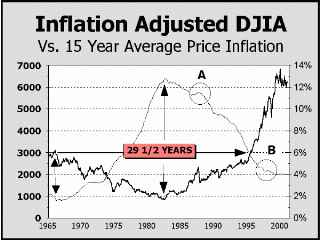
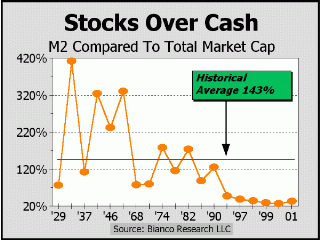
The recent PPI & CPI inflation reports highlight the threat we outlined on this site months ago. This threat is also the subject of an article we wrote for BARRON'S on November 25, 1996. Your local library may very well have this copy of BARRON'S on file for your perusal. The article is entitled, "A New Law? Call it the conservation of inflation." We urge you to read it. In short, the theory is that stock prices are responsible for inflation (or lack thereof), not the other other way around as the conventional thinking has it. In the chart at left, we see clearly how the cycle for prices ends when the cycle for inflation begins and vice versa. Basic economic fact: prices rise when there is an excess of demand and fall when there is an excess of supply. Note the two circled areas, where stocks briefly plunged and inflation rose. At this particular point in time, stocks drive the economy like never before, so the rising demand for stocks has meant lower inflation. Now, with lessened demand, money is coming out of stocks and going back into the economy and driving other prices higher. Given that our 15-year rate of inflation will soon be dropping very favorable monthly CPI numbers recorded from April 1986, the average rate of inflation is about to rise and signal a further and far more substantial drop in stock prices adjusted for inflation. Note how the line for inflation has already carved out a pan shaped bottom while stocks adjusted for inflation appear to have topped! Yet another secular reversal appears to be at hand. After more than a decade of readings in the very lowest portion of our chart, M2 as a percentage of total stock market capitalization has finally - albeit imperceptibly - turned up from the record low of 26.7% on March 31, 2000 to 33.4%. Any reversal in this long term downwards trend could be the precursor to a secular turn. If a secular reversal achieves only half the historical average, stocks will fall by more than 50% from where they now trade. Again, the charts clearly illustrate that stocks have been more important than the economy and in this case, more important than money itself.
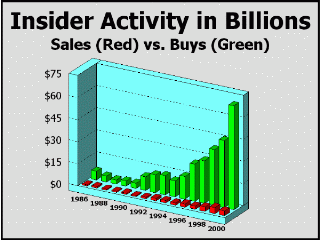
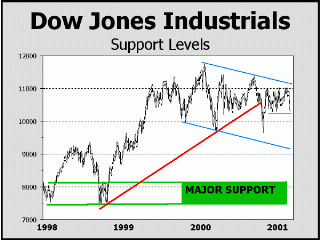
We showed a different perspective of our next chart in Crosscurrents a couple of months ago and it was immediately picked up by Alan Abelson for his column in BARRON'S. Insiders have long had the reputation of leading the market and clearly, they should know best if the shares of their companies provide good value or not. Typically, since their "inside" holdings are huge by comparison to their other investments, insiders sell more stock of their companies than they buy. A lot more. But as the 90s progressed, particularly as the mania expanded into 1996 and beyond, insider sales took off and absolutely blew off the roof. As the final year of the millennium wound down, insiders sold an incredible $21.56 of stock for every dollar of stock they bought. We consider this conclusive proof that the shares of their companies were the worst possible investments. We usually end our report with a guess or estimate on how far the bear market can go in terms of price. Today's analysis is designed to afford a look at a possible major support level to be broached later this year or possibly next year. Further out, the targets we have previously presented for lower prices are all possibilities that we will continue to review from time to time. What stands out most on today's chart of the Dow Industrials is that despite the many continued proclamations of a bull market and even more denials of a bear market, the Dow has literally gone nowhere for close to two years! The red line represents the bull trend from the October 1998 Fed induced bottom, finally broken in the autumn of 2000. The parallel blue trend lines have outlined a new trend in place, actually commencing late in the move of the prior bull trend and continuing to date. The light brown support line represents the bulls last and best hope for containment and reversal. Any break that lasts longer than a day should eventually lead to another test of the lower declining blue trend line, but fair warning, that test may be months away! Last year's print low was 9654 and a test of that level seems remote at this juncture, considering the very oversold nature of today's market. However, we expect that overall, prices will trend lower for many months to come, as always, punctuated by rallies to offer bulls continued hope. We see a protracted decline as in 1973-1974 as a most likely scenario, hopefully ending the bear market at the zone we have pegged at major support between 7500-8200.
As prices for S&P 500 plunged last Friday to their lowest reading since February 2, 1999, Wall Street's big shot strategists were still in the mood to only admit to an "earnings recession," as voiced by Jeffrey Applegate on CNBC that afternoon. Bear market? No such animal! Business is business, and the business of Wall Street is to lure investors into the arena, not to keep them away. Nowhere do we see the kind of attitude that presents us with the evidence that investors, both public and professional, recognize what has transpired. Instead, what we see is the continued reliance and faith upon the "long term" to correct all errors in judgment and to alleviate all poor investment decisions. In order for a bear market to end, the players must act as if a bear market is in place. We are still far from that juncture. As long as Wall Street pros cannot admit to missing the awful deterioration in place for two years, until CNBC's reporters approach the end of the mania with trepidation, until newsletter writers show their readers real fear, and until the public palpably recognizes the bear, a new bull market cannot commence. Our downside targets for
the 2001 are:
Our upside target potentials
for the remainder of 2001 are as follows:
Alan M. Newman, February 24, 2001
All information on this website is prepared from data obtained from sources believed reliable, but not guaranteed by us, and is not considered to be all inclusive. Any stocks, sectors or indexes mentioned on this page are not to be construed as buy, sell, hold or short recommendations. This report is for informational and entertainment purposes only. Longboat Global Advisors, Alan M. Newman and or a member of Mr. Newman’s family may be long or short the securities or related options or other derivative securities mentioned in this report. Our perspectives are subject to change without notice. We assume no responsibility or liability for the information contained in this report. No investment or trading advice whatsoever is implied by our commentary, coverage or charts. |