|
MOST CHART DATA THROUGH APRIL 2, 2001 A SPECIAL REPORT BY ALAN M. NEWMAN, EDITOR LONGBOAT GLOBAL ADVISORS CROSSCURRENTS |
| How can this be? As
Nasdaq continues to crash, as the S&P 500 continues in bear market
territory and as the Dow Industrials race towards their date with a bear
market destiny, Wall Street strategists continue to raise their allocations!
In 37 years of watching the markets, this writer has never seen a display
this brazen by so-called "professionals." The mania has had such
a dramatic impact that whatever the circumstances, be they higher
interest rates, lower interest rates, higher stock prices or lower prices,
all circumstances have led strategists to the same forecast of still higher
stock prices month after month. Thus last Tuesday, Salomon Smith
Barney became the latest firm to raise its stock allocation -- to 70%.
Lest we believe that SSB had turned overly bullish, the firm cut
its year end price target from SPX 1450 to 1400, 26.5% above the day's
close. The firm spokesman said, "We would argue that the go-go days
of the market are unlikely to return in the near term and that investors
need to readjust their expectations to more reasonable returns."
Apparently, the firm's strategists feel that an annualized rate of gain
of more than 35% through the end of the year is justified and equates to
a "more reasonable return." Manic attitudes still prevail!
Put another way, the firm appears to be saying, "We're less bullish now,
so we're raising our allocation to stocks." Clearly, reason and logic
are not skills required for the job of strategist.
The bear market will end when strategists turn bearish.
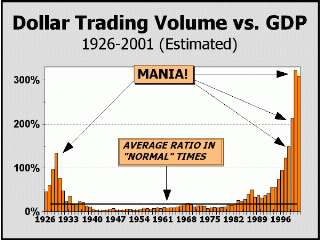
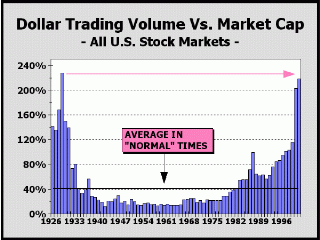
For the first time since we began keeping track of Dollar Trading Volume, we are showing transactional volume at a lower annual rate than before. In the April 2nd issue of Crosscurrents, we closed our commentary with these words, "When significant trends change, trends change significantly." The mania has for all intents and purposes, ended. The greatest bull market in history is now undeniably over, taking with it a secular bull market that has endured since 1982. It is time for the recognition phase of the bear market to commence. For months, investors have been like deer caught in the headlights in the middle of the road, frozen by incomprehensibility, unable to understand what is happening and unable to act. Now, as investors lie by the side of the road, we expect they will soon examine their wounds and act in disgust. We should expect an entire generation of investors to now swear off stocks. From the Beardstown Ladies, to day trading housewives to sixth-grade trading contestants, the world will return to normal. In fact, the ladies had already been shown lacking, underperforming even the S&P 500. Housewives found that short selling was a far more demanding discipline than the long side and momentum "investing." And kids finally found out that the market is not just a one-way street. What's an eleven year old to do? Sell. Rather than focus as we have before on the lunacy that took transactional volume to levels suggesting nothing was more important than stocks, we will now focus on where transactional volume may return to if an entire generation of investors swears off stocks. For starters, there is every reason to believe that at the very least, transactional volume may return to the levels from which the mania commenced. If we are correct that the stock market will be anathema for several years to come, DTV for Nasdaq could decline by more than 92% and DTV for the NYSE could decline by nearly 78%. However, if even a small fraction of the disillusionment we see as probable does indeed occur, both our indicators must trade to levels that imply far lower prices to come. As well, a return to historical norms will take years to unfold.
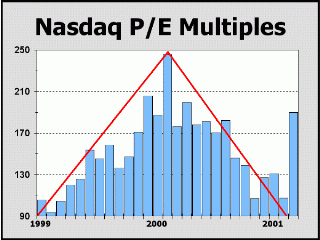
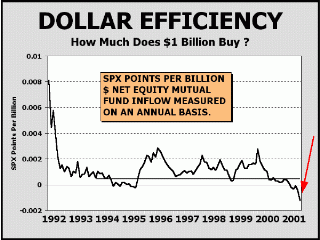
As the mania matured, we pointed out the expanding P/E for Nasdaq on numerous occasions, even comparing the expansion to a financial pyramid wherein there was always one more sucker available to bid prices up to another high. But all pyramids eventually fail and Nasdaq was no exception. At the peak, the stocks that comprise Nasdaq's Composite index traded at an average of nearly 250 times earnings, a phenomenon that is not likely to be repeated in the century to come, possibly never. In the final analysis, stocks can only be worth what the businesses they represent can generate in profit. For decades, analysts have studied "earnings yields" and how they relate to dividend yields, Treasury bills, corporate bonds and even bank CD's, in determining individual stock valuations. Somehow, tradition and reason went out the window in favor of the belief that certain companies were capable of such rapid growth that literally any price was fair. Since many of these companies had no earnings, value was determined by the growth rate of sales. Incredibly, despite not one iota of evidence that profits would ever be turned, valuations via sales became de rigeur. The pyramid was encouraged by corporate managements, who saw the excitement of rapidly increasing prices translated into more shares sold to the willing public, in turn generating even more excitement about the next IPO. As we showed in our last report, insiders unloaded enmasse and finally enabled the slippery slope of the pyramid, a/k/a the other side! If you pay $1,000,000 for a business and make $100,000 a year in profits, that's pretty decent. How much would you pay for a business that yields $4048? At the P/E peak, Nasdaq investors paid the same $1,000,000! Incredibly, even as Nasdaq has crashed, so have earnings, taking Nasdaq's P/E again to ludicrous extremes! You can do just so much with money and it doesn't matter how much you invest. It's an economic fact that when prices climb too high, demand slackens and supply increases. Dollar Efficiency has been a strong theme in our work for many years, in individual stock analysis and in measuring overall market potential. Dollar Efficiency exploded into the early part of 1995, enabling prices to rise rapidly and efficiency remained positive for nearly the entire mania, with only a very brief trip into negative territory as the the Long Term Capital Management fiasco led the financial markets to the precipice in 1998. The Fed induced rate-cut bottom led to another rapid expansion in efficiency into the final phase of the mania, when prices became unsustainable. As our pictures vividly illustrate, efficiency has fallen off a cliff and is more deeply negative than at any time in the past decade. What does negative efficiency actually mean? Addtional dollars invested bring lower prices! At present, no amount of money can support stocks. Even today, prices are still too high!
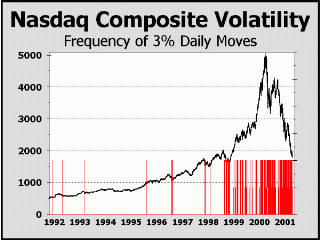
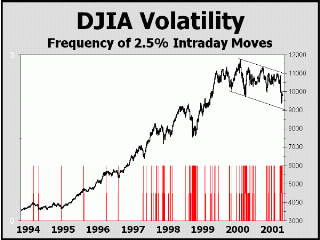
There is no greater killer of bull markets than volatility. The theory is simple. When investors and speculators make their decisions, they expect and depend upon a modicum of price stability. Without stability, the decision to buy or sell short can be proved wrong in a heartbeat and this circumstance tends to lower confidence. Less confidence means some traders will pull back from making decisions. This in turn, impacts liquidity. Although some would argue that traders do not account for a sufficient share of overall transactional volume, the impact on the margin is sufficient to alter liquidity. And as liquidity suffers, volatility increases even more. In 1987, this was one of the factors that led to the crash, but that particular event was influenced far more by so-called portfolio "insurance." It is worthwhile noting and incredibly ironic that the mania has thus far, lessened the odds for a crash. How so? In 1987, the portfolio insurance game required that some funds take money off the table as prices declined. As sophisticated formulas to "stop out" and unwind holdings were triggered, they in turn blindly triggered the "stops" of other funds. In essence, the snowball rolled downhill until it developed into an avalanche. Today, the rationale has turned 180 degrees and funds believe they have a franchise to be fuilly invested. Thus, less stock has been sold and less stock continues to be sold on a relative basis to 1987, even as volatility increases. This "supportive" irony does not necessarily have to continue. At some point, the same hysteria that applied to the upside may apply to the downside. Investors could conceivably look for the exits en masse. The picture of Nasdaq volatility shows a solid wall of rapid movement, sufficient to take the boldest players out of the equation. Liquidity on Nasdaq is nil. Volatility on the NYSE has increased substantially, but still presents a haven of stability relative to Nasdaq. This is the principle reason that prices have declined more slowly. Should volatility expand on the NYSE the
way it has on Nasdaq,
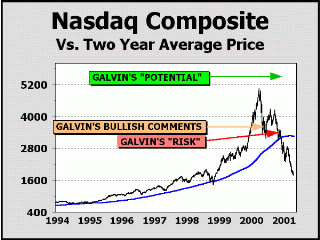
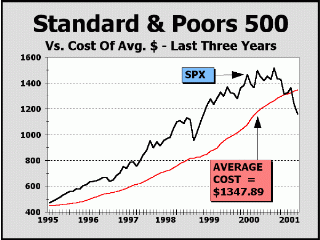
How does the recognition phase begin? With each new brokerage or mutual statement opened by investors, the odds increase that patience is about to become a habit of the past. As our left hand chart shows, Nasdaq has plunged precipitously below its average price over the last two years. Nasdaq has been the index of dreams and fantasy and was hailed even by the "pros" as a one way ticket to riches. So much so, that in April of last year, Tom Galvin, the chief equity analyst for Donaldson, Lufkin & Jennrette was quoted as saying that "Over the next 12 months, we believe the Nasdaq has 200 points of downside risk and 2000 points of upside potential, creating a ten-to-one ratio of reward to risk which makes this an opportune time to be aggressively buying stocks." Below, we have placed a tan arrow at the time of Galvin's forecast, a green arrow to show the potential he afforded price and a red arrow to show the risk parameter Mr. Galvin accorded Nasdaq. Quite obviously, Mr. Galvin was as wrong as one could possibly be. As of last Tuesday's close, Nasdaq is 48.5% below its two-year average price! But Wall Street strategists stuck together throughout the decline, upping their allocations to stocks as time progressed and as prices declined, keeping clients in the hunt. By last week, 16 top strategists were recommending that 69.5% of client portfolios be in stocks, the highest stock allocation in history. Wrong all the way down! But bad advice cannot change the numbers on the statements. The action of the major indexes in the month just ended will open many eyes. Wide. Our right hand picture shows that even S&P 500 index investors with a three-year time frame are now underwater for the first time since the mania commenced. In fact, they are under water by 17.8% as of the Tuesday, April 3rd close. Three years is a long time. When accompanied by the recognition that the time has been for nought, three years can feel like forever. The financial industry is doing everything to assuage investor fears by pushing the long term thesis and are attempting to identify positive results for all long term timeframes. But what if investors abandon the long term thesis?
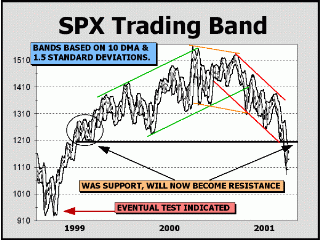
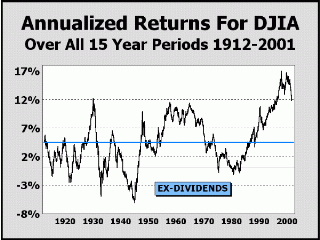
In our last update, we pegged the Dow 9200 level as our target and this level was achieved in less than one month. On March 22nd, the Dow Industrials traded as low as 9106 print basis. In truth, we had not expected prices to decline so dramatically in such a short span of time and this has influenced our annual target, which is now lowered to somewhere between 7500-8200. We hope to "fine tune" as time goes on. Our analysis of the S&P 500 concurs, affording a target low of about 920 at some point later this year. Note the green trendlines highlight the final bull phase of the mania, then the tan trendlines highlight the topping phase and finally the red trendlines highlight the intial bear market plunge. Incredibly, the SPX has even broken below the rapidly declining lower red trendline. We had previously predicted a test of the circled consolidation zone from early 1999 at just under 1210. The line we have drawn below that area was support and did indeed hold again at 1214 print basis on March 2nd, before finally falling on March 12th. In our analysis, old support levels become new resistance levels and we believe the 1205-1210 area will now represent substantial resistance for any future rallies. Although we can make allowances for a penetration as high as 1275-1285, these higher levels should be catalyzed by short covering and not the brave new world of a new bull phase. We look for our target area, from 890 to 950 to be achieved later this year. The parade of guest "professionals" on CNBC, all proclaiming the long term mantra, has become obnoxious and offensive to our sensibilities. Conscience dictates reason and reality dictates that we alert you to what history has shown is achievable. Today we heard one money manager interviewed on CNBC claiming that "If you have a 15 year time horizon, blah, blah, blah......you would be well advised to START buying stocks now." This idiotic advice assumes you have not previously listened to the same mantra before and have never purchased stocks before. If you had, of course, your nest egg would already be deep into the red. But for the moment, let's assume you are a brand new investor. From what we see, given the recent prolonged period in which returns were far greater than the historical average, the next decade might easily produce gains well under the historical norm. For all 15-year periods since 1912, the annualized return for the Dow Industrials ex-dividends has been about 4.8%, represented by the blue bold line drawn across our chart. How low does the Dow have to go for returns to approach the historical norm? Rather than answer in terms of price, let's answer in terms of time. Using the Dow's recent print low of 9106 achieved on March 22nd, the historical norm of 15-year annualized gains of 4.8% will be "hit" in January of 2010 if the Dow trades at the same level. So, someone who buys today and holds until then would achieve a perfectly normal rate of return for the Dow with the Dow trading at lower prices than today. So much for the long term mantra.
Truthfully, we hadn't considered updating this page so early in the month, but with our vacation looking on the horizon, we felt our readers and visitors deserved our initial views on the "official" bear market and deserved to see our price targets updated. We urge you to stay tuned for our next update, which is targeted to appear on May 26th. In this update, as we have done twice a year in Crosscurrents, we will present our proof that the stock market can be timed. Wall Street does not want you to know this dirty little secret. Wall Street believes your assets belong in the hands of "professionals" year round, quite probably the same professionals that were high on the Internet stocks at the top, that believed that "new economy" stocks were cheap, and that have been increasingly bullish as stocks have declined. From their closing highs:
Strategists have increased allocations every step on the way down, exposing their firm's clients to larger and larger losses. Should we believe them now? Our downside targets for
2001 are:
Our "best case" upside
target potentials for the remainder of 2001 are as follows:
Alan M. Newman, April 3, 2001
All information on this website is prepared from data obtained from sources believed reliable, but not guaranteed by us, and is not considered to be all inclusive. Any stocks, sectors or indexes mentioned on this page are not to be construed as buy, sell, hold or short recommendations. This report is for informational and entertainment purposes only. Longboat Global Advisors, Alan M. Newman and or a member of Mr. Newman’s family may be long or short the securities or related options or other derivative securities mentioned in this report. Our perspectives are subject to change without notice. We assume no responsibility or liability for the information contained in this report. No investment or trading advice whatsoever is implied by our commentary, coverage or charts. |